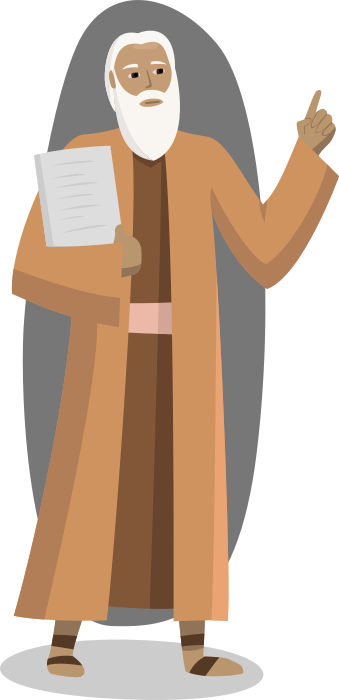
Moses, depicted as an elderly man with a flowing white beard wearing traditional robes. He stands with authority holding a stone tablet representing the Ten Commandments, with his finger raised in a gesture of divine instruction and proclamation.

“The Lord will fight for you; you need only to be still.”

Exodus 14:14

“Be strong and courageous. Do not be afraid or terrified because of them, for the Lord your God goes with you; he will never leave you nor forsake you.”

Deuteronomy 31:6

“But now, please forgive their sin—but if not, then blot me out of the book you have written.”

Exodus 32:32

“Hear, O Israel: The Lord our God, the Lord is one. Love the Lord your God with all your heart and with all your soul and with all your strength.”

Deuteronomy 6:4-5

“The eternal God is your refuge, and underneath are the everlasting arms. He will drive out your enemies before you, saying, 'Destroy them!'”

Deuteronomy 33:27

Are you done?

Check the box to make progress on this character.

Moses

This page includes depictions of biblical events including violence, warfare, and mature themes as described in the original biblical narrative.

The shepherd who parted the sea and delivered the ten commandments.

Moses' Life Story

Swipe to read

Swipe to the left
Moses as an elderly bearded leader standing confidently in traditional robes, with the vast desert wilderness and distant mountains behind him, representing his role as the great lawgiver and prophet.

Right from his birth, God had a good plan for the life of Moses. He was set aside to do great things in the history of Israel. Moses played a significant role as a Prophet and leader of God's people, despite several challenges that came along his journey of life.

Pharaoh's daughter in ornate Egyptian royal clothing and jewelry discovering baby Moses in a woven basket floating among the reeds along the Nile River, reaching down to lift him from the water.

Moses was born into a Hebrew family at a time when Pharaoh, King of Egypt, gave an instruction for all Hebrew newborn males to be killed. Moses' mother hid him for three months until she could not hide him anymore. She put him in a basket and set it on a river where Pharaoh's daughter took him in as her own.

An Egyptian taskmaster with a whip striking a Hebrew slave, while other enslaved Israelites labor in the background carrying bricks near a pyramid, depicting the harsh slavery in Egypt.

Moses grew up as an Egyptian, but he did not behave like them. He was bittered by the living condition of the Hebrews who were slaves in the land of Egypt. One day, he saw an Egyptian beating up a Hebrew slave and out of anger, Moses fought and killed the Egyptian, then ran away afterwards.

Young Moses as a shepherd kneeling in reverence before the burning bush, with his sandals removed and stars shining on the night sky, as divine flames engulf the thorny bush without consuming it.

Moses married Zipporah, daughter of Jethro and one day as he was caring for his sheep, he encountered God in form of a burning bush. God gave him a divine task to set the Israelites free from slavery in Egypt, and despite many obstacles, Moses agreed to carry out this task, with God by his side.

Israelites in the wilderness gratefully collecting white manna that has fallen from heaven like bread, filling their baskets and vessels while children and families gather the divine provision.

The Egyptians tried and failed, but Moses led the Israelites out of Egypt to the promised land, through the wilderness where they spent forty years. God took care of them even in the wilderness through Moses who performed many miracles like striking the rock to bring forth water to drink and providing manna and quail as food.

Moses observing from a distance as groups of Israelites talk and complain among themselves in the desert camp, showing the leadership challenges he faced with a rebellious people.

The Israelites had a mind of their own, leading them was not always easy for Moses. They would sometimes grumble and complain, and even wish to return to Egypt as slaves, but Moses remained strong in his leadership, providing help when he could and speaking to God on behalf of the Israelites.

An aged Moses with flowing white beard standing on Mount Nebo, looking peacefully toward the Promised Land across the Jordan River valley, knowing his earthly journey is complete.

Their grumble made Moses to disobey God, and God said he would not see the promised land. Moses only climbed Mount Nebo where God showed him the promised land from a distance. This was where he died, and from there, Joshua led the Israelites to the promised land.
Are you done?

Check the box to make progress on this character.

Important Events

Moses kneeling before a burning bush that glows with divine fire, removing his sandals on holy ground as God speaks to him in the wilderness.

Moses and the Burning Bush

Moses was taking care of his Father-in-law's sheep in the desert when he had a wonderful encounter with God. An angel of God appeared to him as a flame of fire on a bush. However, the bush was not burned by the fire, even as the flames of this fire were burning. Moses was surprised by this and tried to go closer to see how this was happening when he heard a voice saying, “Moses, take off your sandals for you stand on Holy ground.”

God had an important task for Moses, and that was to set the Israelites free from slavery in Pharaoh's kingdom. Moses was scared of this task because he was timid and worried about what the people would say, but God's appearance and assurance to him let him know that this assignment was divine and that the all-powerful and superior God was on his side.

Exodus 3:1-15
Ancient Egyptian temple and buildings surrounded by swarms of locusts and other plagues sent by God, with dark clouds overhead during the ten plagues.

Confrontation with Pharaoh and the Ten Plagues

When Moses and Aaron told Pharaoh to let the Israelites go, he refused. Instead, he made the Israelites work harder so they would have no time to plan their exit from Egypt. However, God knew that Pharaoh would not let the Israelites go easily, so He had a plan to teach him a hard lesson. God called Israel His first-born son, so He chose to kill the first sons of Egypt slowly. To do this, God sent ten plagues while forcing Pharaoh to release the Israelites.

The ten plagues include water in the Nile River turning to blood, infestation of frogs, lice, flies and locusts, a deadly disease killing the livestock, boils being found on the bodies of Egyptians, a hailstorm destroying crops and vegetations, severe darkness in the land, and lastly, the death of all first-borns of the Egyptians. This was when Pharaoh finally let the Israelites go.

Exodus 7-12
Moses stretching out his staff as the Red Sea parts, creating towering walls of water on both sides with dry ground for the Israelites to cross.

The Parting of the Red Sea

After Pharaoh let the Israelites go, his heart was hardened again and he decided that they did not deserve to go. He called on his mighty captains and they went upon six hundred chariots to chase down the Israelites and bring them back to Egypt to continue as their slaves. God was about to use this to his glory, but the Israelites thought they were in trouble. They yelled at Moses saying, “You should have left us to remain slaves to the Egyptians than bring us out to die here.”

Moses heard from God, and he stretched his rod towards the sea in front of them. The sea opened up and there was dry land for them to cross. The Egyptians saw this and continued the chase, but after Moses and the Israelites crossed, Moses stretched his rod again to the sea, and it closed up, swallowing all the Egyptians.

Exodus 14
Moses standing on a rock holding two stone tablets inscribed with the Ten Commandments, with the Israelites gathered below.

Moses Receiving the Ten Commandments

After the Israelites were delivered from Pharaoh and his commanders, they were camped in the wilderness of Sinai, just before Mount Sinai. God wanted the Israelites to pledge their obedience to Him; therefore, He told Moses to confirm their position. He reminded the Israelites of the help He granted them, and said if they would obey Him, then He would keep them safe and blessed. The Israelites agreed, saying they would do all that God asks of them.

God spoke to the Israelites from heaven on the Ten Commandments, but the power of His presence scared them so much that they told Moses to speak with God alone and pass the message to them. Thus, Moses went up Mount Sinai for forty days and nights, hearing from God all that He had as the laws to guide the Israelites. After these days, God handed Moses two tablets of the law.

Exodus 19-20; 31

Are you done?

Check the box to make progress on this character.

Fun Facts

Name Meaning

While the Israelites were slaves in Egypt, a Hebrew woman gave birth to a boy. She determined to keep him at all costs, hiding him for three months and dropping him off in a basket at the bank of the river that the Egyptian princess used to bathe in.

The Princess loved him and took him home. She called him Moses, meaning “I drew him out of the water”.

Exodus 2:1-10

Moses Was a Stammerer

God sent Moses to Egypt to set his people (Israel) free, He gave him several instructions accompanied with signs to give to Pharaoh specifically.

Moses opposed God's instructions, saying he wasn't so eloquent that he stammers.

Therefore, God appointed Aaron (Moses' brother) to serve as Moses' assistant and mouthpiece, and this gave Moses the needed confidence.

Exodus 4:10

Moses' Miracles

God used Moses to perform a lot of miracles. His rod turned into a snake, and it swallowed those of Pharaoh's sorcerers. Moses's hand turned white like he had leprosy, and it became normal after he put it back in his robe.

Moses parted the Red Sea by stretching his rod, and the Israelites walked on.

Exodus 4:2-7; 7:19-21; 14:21-22

Shining Face

While the Israelites were in the wilderness, Moses went up to Mount Sinai for forty days and nights, where he received the tablets containing the Ten Commandments from God. Moses' face shone when he came down from the mountain because he had spoken to God face to face.

Exodus 19-20; 34:29; Deuteronomy 5:6-21

Moses Never Entered the Promised Land

When the Israelites suffered water scarcity in the wilderness, God told Moses to speak to a rock, and water would come forth. Instead, Moses struck the rock with his rod, and God got angry. He told Moses he wouldn't get to Canaan.

God showed Moses the Promised Land (Canaan) on Mount Nebo in Moab, but he didn't make it there.

Deuteronomy 3:27; 4:21-22; 32:48-52; Numbers 20:6-12

Healthy as Ever

Moses died in the land of Moab, according to God's word, at the age of a hundred and twenty. He was buried at the valley near Beth-Peor, but to this day, no one knows his grave.

Moses, before he died at 120 years, had very clear vision, and he was as strong as ever.

Deuteronomy 34:5-7

Are you done?

Check the box to make progress on this character.
Moses, depicted as an elderly man with a flowing white beard wearing traditional robes. He stands with authority holding a stone tablet representing the Ten Commandments, with his finger raised in a gesture of divine instruction and proclamation. Moses, depicted as an elderly man with a flowing white beard wearing traditional robes. He stands with authority holding a stone tablet representing the Ten Commandments, with his finger raised in a gesture of divine instruction and proclamation.

Quiz

? ? ? ?

Where You Can Find Him

Where You Can Find Her

Book icon

Books and chapters

  • Genesis
  • Exodus 2-40
  • Leviticus 1; 5; 7-8; 11-27
  • Numbers 1-20; 26-36
  • Deuteronomy

Other Characters

Contact Us

Can We Improve?

If you have anything on your mind that you would like to share with us, feel free to leave us a message!

We strive to make Bible Characters a fun and educational platform. Are some of our facts wrong? Or do you have any fun ideas? Please let us know!

0%